
UCP vs ACP: The Two Protocols That Decide Which Stores AI Agents Recommend
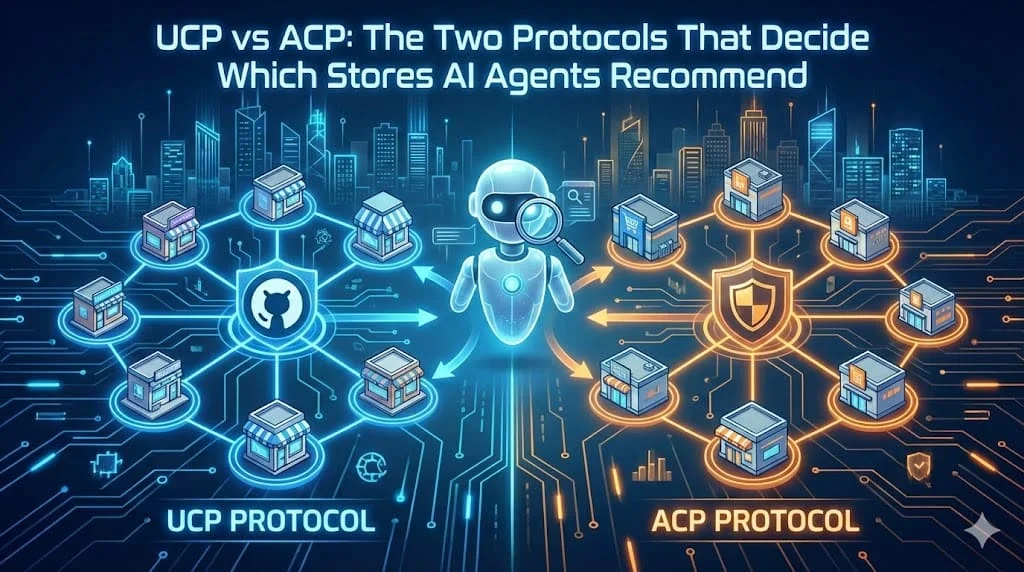
In January 2026, Google and Shopify announced the Universal Commerce Protocol (UCP). Months earlier, OpenAI and Stripe launched the Agentic Commerce Protocol (ACP). These two protocols now control which online stores AI agents can discover, recommend, and transact with. If your store does not support at least one of them, AI shopping agents cannot see you. Period.
This is not a theoretical shift. Google AI Mode is already live. ChatGPT Instant Checkout is processing real transactions. Walmart checks out inside Gemini. JD Sports sells through ChatGPT. The infrastructure for AI-mediated commerce is built and running. The question is no longer whether this matters. It is whether your store is visible to it.
For competitive intelligence teams, these protocols create a new dimension of analysis. Your competitors' UCP manifests are public, crawlable, and rich with strategic data. This article breaks down both protocols, explains what they reveal about your competitors, and shows how to use that intelligence.
What Is UCP (Universal Commerce Protocol)?
UCP is the robots.txt of AI commerce. Co-developed by Google and Shopify with partners including Target, Walmart, Etsy, and Wayfair, UCP provides a standardized way for merchants to declare their commerce capabilities to any AI agent.
The protocol works through a publicly accessible manifest file at /.well-known/ucp on a merchant's domain. Any AI agent can fetch this file to discover what the merchant supports: checkout, catalog search, order management, payment methods, fulfillment options, and more.
What Lives Inside a UCP Manifest
- Services: Which commerce APIs the merchant exposes (REST, MCP, Agent-to-Agent)
- Capabilities: Checkout, discounts, fulfillment, loyalty programs, order management, catalog search
- Payment handlers: Google Pay, Shop Pay, Apple Pay, PayPal, Stripe, Adyen
- Signing keys: Cryptographic identity verification for secure transactions
- Extension support: Delivery windows, subscription schedules, split shipments, pre-orders
Think of it as a machine-readable business card that tells AI agents exactly what the store can do and how to interact with it.
The critical detail: UCP manifests are public by design. They must be accessible so that AI agents can discover merchants without pre-configured integrations. This creates a massive competitive intelligence opportunity that most brands have not realized yet.
What Is ACP (Agentic Commerce Protocol)?
ACP is OpenAI and Stripe's answer to the same problem, but with a different philosophy. Where UCP is decentralized (any agent can crawl any merchant), ACP is centralized (merchants apply through ChatGPT's commerce onboarding and configure through Stripe's dashboard).
UCP vs ACP: Key Differences
| Dimension | UCP (Google + Shopify) | ACP (OpenAI + Stripe) |
|---|---|---|
| Discovery | Decentralized (/.well-known/ucp) | Centralized (ChatGPT onboarding) |
| Primary surface | Google AI Mode, Gemini, Copilot | ChatGPT Instant Checkout |
| Payment | Modular (Google Pay, Shop Pay, etc.) | Stripe required (4% fee) |
| Cart support | Multi-item carts | Single-item only (currently) |
| Geography | Global from launch | US only for instant checkout |
| Product catalog | Google Shopping Graph (50B+ listings) | Merchant feeds only |
| Manifest visibility | Public and crawlable | Private (Stripe dashboard) |
The industry consensus is clear: implement both. Google launched UCP at NRF 2026 with 25+ partners including Shopify, Walmart, Target, Visa, and Mastercard. UCP captures top-of-funnel discovery intent (people searching via Google and Gemini). ACP captures deep-funnel conversational intent (people buying inside ChatGPT). Supporting both protocols captures the widest agentic traffic surface.
Why This Matters for Competitive Intelligence
Here is where it gets strategic for eCommerce teams. Because UCP manifests are public and sit at a known URL on every merchant's domain, they are crawlable competitive intelligence. You can see exactly what capabilities your competitors have enabled, which payment methods they support, which transport protocols they expose, and how current their implementation is.
What You Can Learn From Competitor UCP Manifests
- 1. Agentic commerce readiness: Does the competitor have a UCP manifest at all? If yes, they are visible to AI shopping agents. If not, they are invisible.
- 2. Capability depth: Do they support checkout only, or do they also expose catalog search, order management, loyalty programs, and fulfillment options?
- 3. Payment infrastructure: Which payment handlers do they list? Google Pay, Shop Pay, Apple Pay, PayPal? More payment options means more ways AI agents can complete transactions.
- 4. Transport protocols: REST only, REST + MCP, or REST + MCP + Agent-to-Agent? More protocols means more types of AI agents can interact with them.
- 5. Fulfillment sophistication: Delivery windows, subscription schedules, split shipments, in-store pickup. Richer fulfillment data gets preferential treatment from AI agents.
- 6. Version freshness: Are they on the latest spec version or lagging behind? Outdated versions signal abandoned implementations.
This is the kind of intelligence that was previously impossible to extract at scale. With UCP, it is structured, standardized, and sitting on a public endpoint waiting to be analyzed.
How Trendos Tracks UCP Adoption for Clients
Trendos already monitors 30+ competitive dimensions for eCommerce brands. UCP manifest analysis extends this with a new layer of structured intelligence that feeds directly into the Agent Readiness Score.
What Trendos Monitors
- UCP manifest presence: Binary detection across all monitored competitor domains. The most critical alert is when a competitor enables UCP and you have not.
- Capability comparison matrix: Side-by-side view of which capabilities each competitor supports (checkout, discounts, fulfillment, loyalty, orders, catalog).
- Payment method intelligence: Track which payment handlers competitors expose to AI agents and identify gaps in your own payment coverage.
- Change detection: Real-time alerts when competitors add new capabilities, upgrade protocol versions, or enable new payment methods.
- Agent Readiness integration: UCP data feeds into the 5-pillar scoring model (Schema, TechAccess, Content, Trust, AI) with hard data rather than heuristic estimates.
What You Should Do Right Now
1. Check If Your Competitors Have UCP Manifests
Visit https://competitor-domain.com/.well-known/ucp for your top competitors. If they return a JSON manifest, they are already visible to AI shopping agents. If you are not, you are losing discoverability every day.
2. Audit Your Structured Data Foundation
UCP builds on top of structured data. If your Schema.org markup is incomplete, AI agents cannot understand your products even before UCP enters the picture. Product, Offer, AggregateRating, BreadcrumbList, MerchantReturnPolicy, and ShippingDetails are the minimum.
3. Implement Both Protocols
If you are on Shopify, UCP is available through Agentic Storefronts. For custom platforms, you need to implement the REST endpoints, publish the manifest, and configure Google Merchant Center. For ACP, integrate with Stripe and apply through ChatGPT commerce onboarding. Dual implementation captures the widest agentic traffic.
4. Monitor Competitor Adoption Continuously
This is not a one-time check. Competitors are enabling UCP and ACP every week. Trendos monitors these changes in real time and alerts you when the competitive landscape shifts. For a broader framework covering all 10 essential Competitive Intelligence capabilities for 2026, read our complete eCommerce competitive intelligence guide.
The Bottom Line
UCP and ACP are not optional upgrades. They are the new gatekeepers of AI-mediated commerce. Reddit now reaches 121 million daily active users and 471 million weekly, with AI search users surging 30% year-over-year to 80 million. Reddit launched AI-powered shopping carousels in February 2026, while the competitive intelligence tools market is projected to reach $96 billion by 2030 (Research and Markets). If your store is not structured for these protocols, you are invisible to the fastest-growing distribution channel in eCommerce.
The brands that move first do not just get a technology advantage. They get a compounding data advantage as AI agents learn to prefer merchants with richer, more complete commerce capabilities. Every week you wait, your competitors' agentic commerce moat gets deeper.
Want to see where you stand? Book a demo and we will show you your Agent Readiness Score alongside your competitors' UCP status. Or start with our Agent Readiness feature to see the full picture.